Supplier concentration and single-source risk
The most concrete risk question procurement has: which suppliers are single points of failure, and where does a second source actually help?
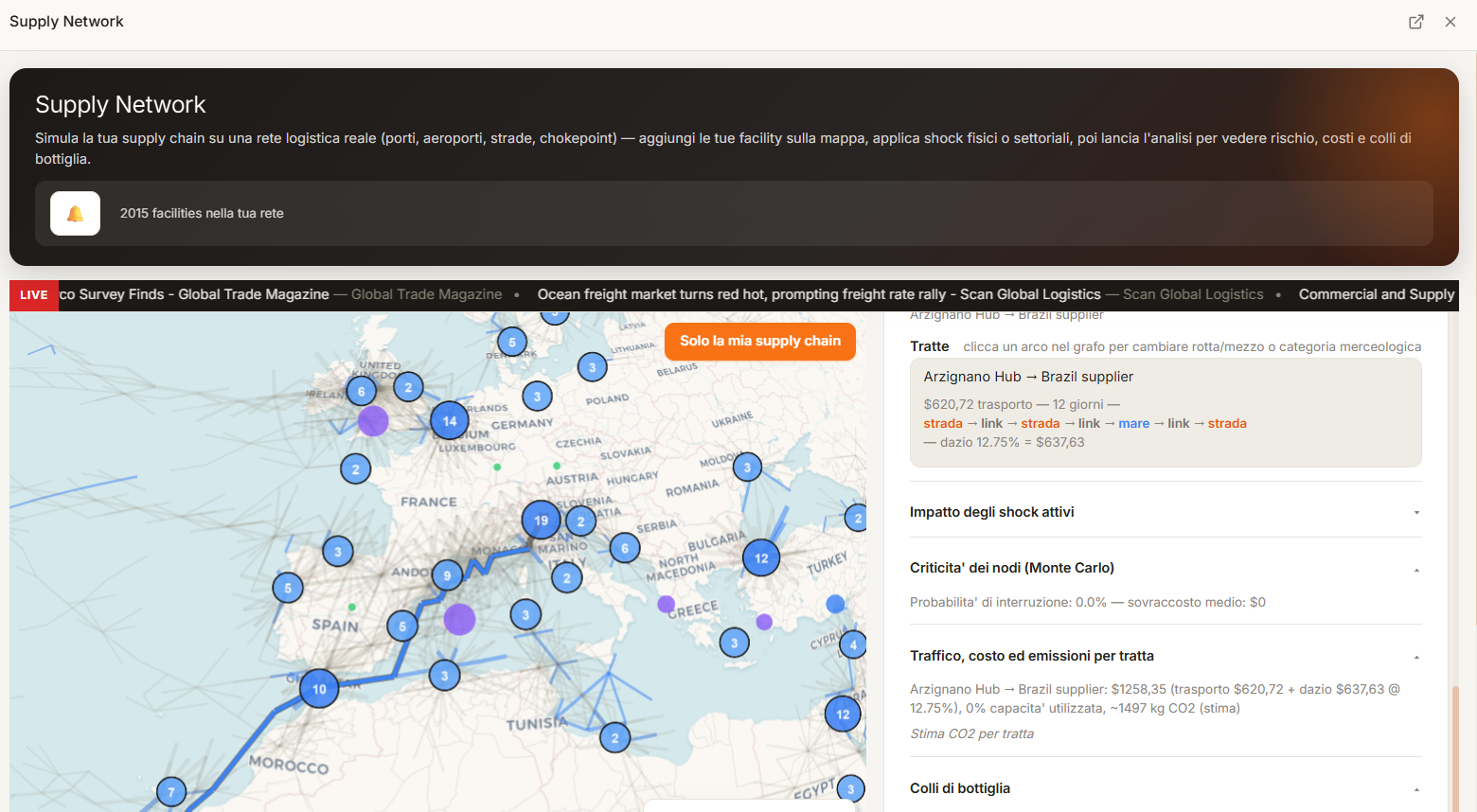
This supplier concentration risk tool runs in your browser. Datastripes scores your supply base with the Herfindahl index, counts single-source parts, and measures country and region share, then shows where a disruption would converge on one supplier, one plant or one border crossing.
The distinction
Concentration and single-sourcing are not the same problem
A part can have three qualified suppliers and still be concentrated if 90% of spend goes to one of them. A part can be single-sourced but low-risk if the supplier is stable, substitutable and holds buffer stock. You need both readings.
Datastripes reports the Herfindahl index (spend concentration), the count of truly single-source parts, and the geographic convergence points where several suppliers share one country or one route.
What it measures
Three metrics, computed
Herfindahl index
Sum of squared supplier spend shares, per category and overall — a standard concentration measure, from 0 (fragmented) to 10,000 (monopoly).
Count and criticality
Which parts have exactly one qualified supplier, ranked by how much downstream value depends on them.
Country and route share
Where multiple suppliers converge on one country, port or chokepoint — hidden concentration.
Add a backup and re-score
Add a second source in one click and see the HHI and single-source count update.
Acting on it
Where a second source actually reduces risk
Dual-sourcing costs money and management attention, so it should go where it moves the risk number. Datastripes ranks single-source parts by downstream exposure, so you dual-source the ones that matter and leave the rest. It also flags cases where a "second source" shares the same sub-tier supplier or the same country — where the diversification is on paper only.
Data and privacy
Nothing you enter is uploaded.
Your supplier list, bills of materials and costs are stored locally in your browser. No account. No upload. Read how that works.
Methods: Monte-Carlo disruption modelling · Leontief input-output cost-push · damped-trend forecasting · safety-stock optimisation. See Methodology & data sources.
Questions
People also ask
- How do you measure supplier concentration risk?
- The Herfindahl index (HHI) sums the squared spend shares of each supplier in a category; higher means more concentrated. Datastripes computes it per category and overall, alongside a single-source count and geographic share.
- What is a single point of failure in a supply chain?
- A node — a supplier, plant, port or route — whose failure stops output because no viable alternative path exists. Datastripes identifies these from the network topology.
- Does adding a second supplier always reduce risk?
- No. If the second supplier depends on the same sub-tier source or ships through the same chokepoint, the concentration is unchanged. Datastripes flags these cases.
- Is it free?
- Yes, and no account is needed.
Related
Keep going
Next step
Find your single points of failure
Your data stays in your device! No account, no upload, no sales call.
Analyse your business chain — it's free!